
We are moving from chatbots that answer questions to AI agents that can perform tasks. And that changes what enterprise IT needs to be prepared for.
Until recently, most AI applications were judged by the quality of their answers. Could they summarise a document, find the right information or interpret a customer request?
Today's AI agents can go further. They can operate software, interact with enterprise applications and coordinate multi-step workflows.
The question is no longer just whether AI can give us the right answer. It's what we're comfortable letting it do.
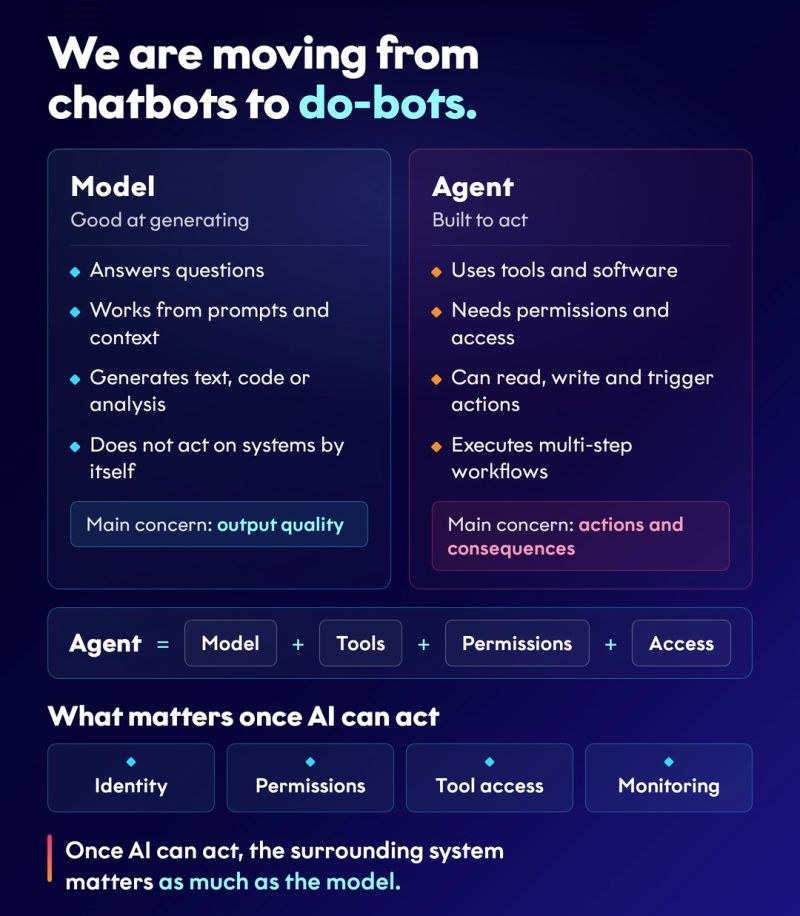
From answering questions to taking action
Consider an AI agent handling a customer request.
It reads an incoming email, identifies the customer's intent, retrieves information from a CRM and checks the relevant contract in a document management system.
So far, it has mostly been gathering and interpreting information.
But what if the next step is to modify a customer record, initiate a payment or update a contract?
The agent is now interacting with business-critical systems. Its actions can have consequences beyond the conversation.
This is where enterprise architecture becomes essential.
The architecture around the agent matters
A capable language model is only one component. The surrounding systems must determine what the agent is allowed to access, which actions it can perform and how those actions are controlled.
Six areas deserve particular attention:
- Identity: Every agent needs a clearly defined identity and an accountable business or technical owner.
- Permissions: Access should be limited to the specific systems, data and operations required. Permissions must be enforced by the underlying systems, not merely described in a prompt.
- Tool integration: APIs and enterprise applications need controlled interfaces with input validation and defined operating limits.
- Approval boundaries: Sensitive or irreversible actions should require explicit authorization or human approval.
- Monitoring and traceability: Important actions, tool calls and approvals must be recorded so outcomes can be investigated.
- Failure handling: Timeouts, failed integrations and partial transactions need defined recovery procedures, including safe retries and compensation where appropriate.
These controls become especially important when agents operate across multiple applications, including legacy systems that were never designed for autonomous interaction.
More capable agents need better systems around them
At MNB Solutions, we see substantial potential in agentic AI for reducing manual work and connecting business processes across existing enterprise applications.
But the objective should not be maximum autonomy. It should be the right level of autonomy for the business process, supported by appropriate technical controls.
Our ISO 42001-certified AI management framework provides the governance foundation. Enterprise architecture turns those principles into working permissions, integrations, approval mechanisms and operational safeguards.
As AI becomes better at acting, the quality of the architecture surrounding it becomes even more important.
The model determines what an agent can do. The system must determine what it is allowed to do.